
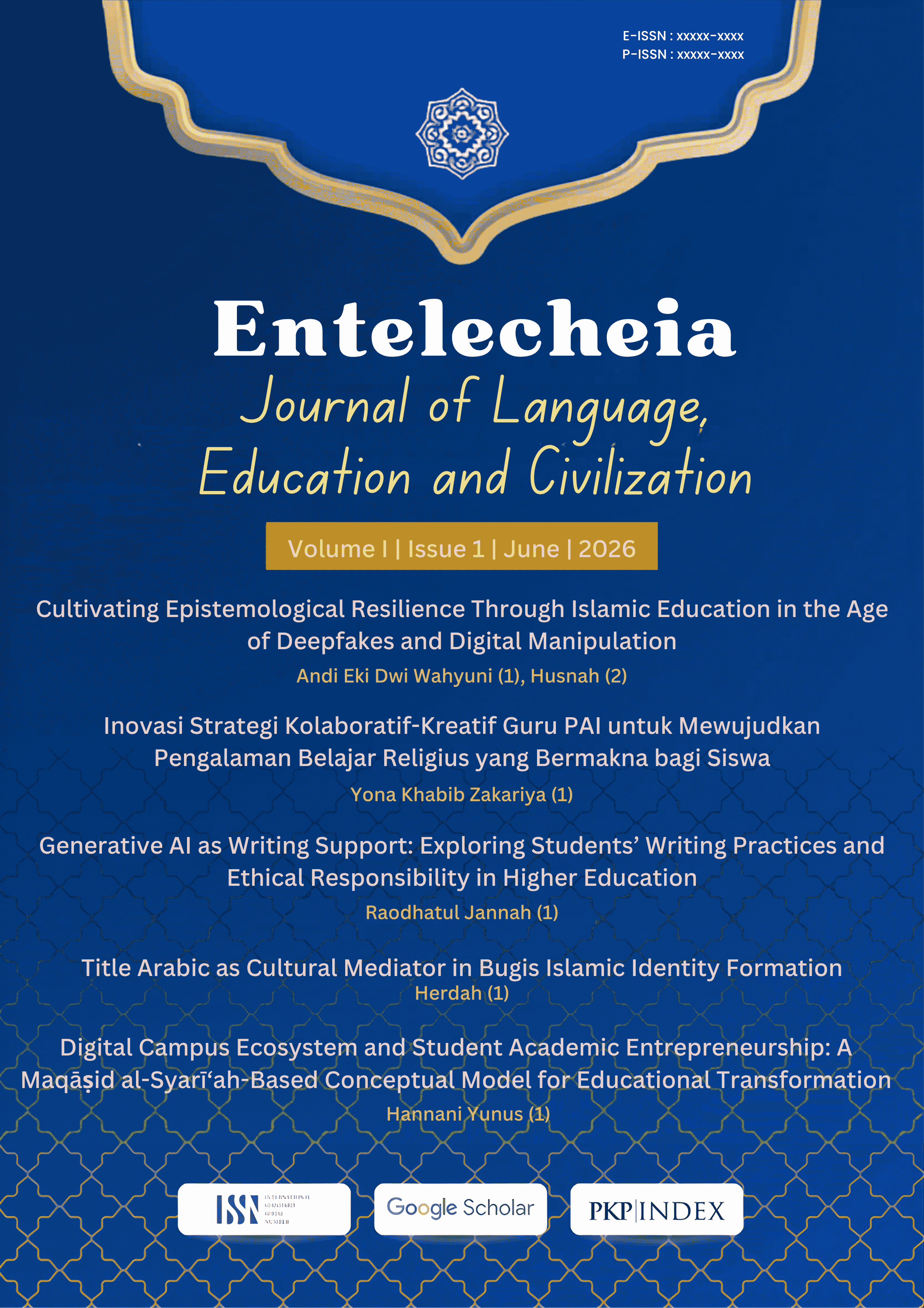
Inovasi Strategi Kolaboratif-Kreatif Guru PAI untuk Mewujudkan Pengalaman Belajar Religius yang Bermakna bagi Siswa
Article Sidebar
Main Article Content
Abstract
Background: The rapid shift of the digital era demands a pedagogical transformation in Islamic Education (PAI) to move beyond conventional, teacher-centered approaches that often result in passive rote learning. Traditional methods frequently fail to generate active student participation, causing a significant gap between theoretical religious knowledge and authentic character internalization.
Purpose: This study aims to analyze the integration of collaborative-creative strategies in PAI and conceptualize how this unified pedagogical framework fosters meaningful religious learning experiences by triggering multidimensional student engagement.
Methods: A qualitative library research approach is utilized, selecting credible academic literature, journals, and books published within the last five years. Data were systematically analyzed using interpretive-critical content analysis to synthesize the relationship between collaborative-creative teaching, multidimensional engagement, and meaningful learning.
Results: The findings reveal that combining collaborative dimensions (dialogue, problem-based cooperation, shared accountability) and creative elements (possibility thinking, media diversification, innovative problem-solving) forms a reciprocal, non-dualistic pedagogical framework. This integration actively drives cognitive, emotional, and social engagement. Consequently, this deep engagement serves as a catalyst for meaningful religious learning experiences, marked by value personalization, existential reflection, social-ecological praxis, and spiritual resilience.
Implication: This study implies that PAI educators must transition from mere knowledge transmission to structured collaborative-creative designs. Furthermore, teacher training programs and curriculum assessment systems should be reformed toward authentic, project-based models to systematically cultivate holistic religious characters.
Originality: This study introduces a novel conceptual model that explicitly links collaborative-creative strategies to meaningful religious learning experiences through the mediating variable of multidimensional student engagement, offering an integrated theoretical framework that synthesizes social constructivism, creative pedagogy, and experiential learning in modern Islamic education.
Downloads
Article Details
Section

This work is licensed under a Creative Commons Attribution-ShareAlike 4.0 International License.
How to Cite
References
Abdullah, M., & Azis, A. (2021). Character education in Islamic learning. Jurnal Pendidikan Islam, 7(2), 189-204.
Anwar, M. (2023). 21st century learning in Islamic education. Jurnal Tarbiyah.
Arifin, Z. (2022). Islamic education in the digital era. Jurnal Pendidikan Agama Islam, 19(2), 145-160.
Bell, S. (2010). Project-based learning for the 21st century: Skills for the future. The Clearing House: A Journal of Educational Strategies, Issues and Ideas, 83(2), 39-43. https://doi.org/10.1080/00098650903505415
Craft, A. (2005). Creativity in schools: Tensions and dilemmas. Routledge. https://doi.org/10.4324/9780203357965
Craft, A., Cremin, T., Burnard, P., & Chappell, K. (2007). Developing creative learning through possibility thinking with children aged 3-7. Thinking Skills and Creativity, 2(2), 108-119. https://doi.org/10.1016/j.tsc.2006.07.001
Fauzi, A., & Widodo, A. (2021). Innovative learning models. Cakrawala Pendidikan, 40(3), 654-666.
Fredricks, J. A., Blumenfeld, P. C., & Paris, A. H. (2004). School engagement: Potential of the concept, state of the evidence. Review of Educational Research, 74(1), 59-109. https://doi.org/10.3102/00346543074001059
Fullan, M., & Langworthy, M. (2014). A rich seam: How new pedagogies find deep learning. Pearson.
Greenstein, L. (2012). Assessing 21st century skills: A guide to evaluating mastery and authentic learning. Corwin Press.
Hidayat, T., & Syahidin. (2020). Inculcating character values in Islamic education. Jurnal Pendidikan Islam, 6(1), 1-14. https://doi.org/10.15575/jpi.v7i1.12515
Hidayati, N. (2022). Teacher creativity in Islamic education. Jurnal Edukasi Islam.
Kolb, A. Y., & Kolb, D. A. (2017). Experiential learning theory as a guide for experiential educators in higher education. Experiential Learning & Teaching in Higher Education, 1(1), 7-44. https://doi.org/10.46787/elthe.v1i1.3362
Kolb, D. A. (1984). Experiential learning: Experience as the source of learning and development. Prentice-Hall.
Latipah, E. (2021). Student engagement in Islamic education learning. Jurnal Pendidikan Islam, 7(1), 75-90.
Lestari, I., & Kurnia, H. (2022). Project-based learning in Islamic education. Jurnal Pendidikan Agama Islam, 19(1), 1-15.
Majid, A. (2021). Strategi pembelajaran. Remaja Rosdakarya.
Muhaimin. (2021). Paradigma pendidikan Islam. Remaja Rosdakarya.
Nata, A. (2022). Ilmu pendidikan Islam. Kencana.
Nurdyansyah, N. (2021). Innovative learning model in Islamic education. Jurnal Pendidikan Islam, 7(2), 115-128.
Partnership for 21st Century Skills. (2019). Framework for 21st century learning. P21.
Prasetyo, Z. K. (2020). Digital collaborative learning. Cakrawala Pendidikan, 39(2), 320-330.
Pratiwi, D. (2023). Creativity in Islamic education learning. Jurnal Inovasi Pendidikan.
Prince, M. J. (2004). Does active learning work? A review of the research. Journal of Engineering Education, 93(3), 223-231. https://doi.org/10.1002/j.2168-9830.2004.tb00809.x
Rahman, A. (2021). Collaborative learning in religious education. Jurnal Tarbiyah, 28(1), 55-68.
Ritonga, M. (2022). Collaborative learning in Islamic higher education. Jurnal Pendidikan Islam.
Sari, M., & Handayani, L. (2023). Creative pedagogy in Islamic education. Tadris: Jurnal Keguruan dan Ilmu Tarbiyah.
Schlechty, P. C. (2011). Engaging students: The next level of working on the work. Jossey-Bass.
Setiawan, D., & Sudrajat, A. (2022). Character education integration. Cakrawala Pendidikan, 41(1), 98-110.
Siregar, R. (2023). Collaborative learning implementation. Jurnal Pendidikan Islam.
Suyadi. (2020). Neuroscience-based Islamic education. Jurnal Pendidikan Islam, 6(2), 121-136. https://doi.org/10.18860/jpai.v6i1.8307
Tafsir, A. (2021). Ilmu pendidikan dalam perspektif Islam. Remaja Rosdakarya.
Thomas, J. W. (2000). A review of research on project-based learning. Autodesk Foundation.
Vygotsky, L. S. (1978). Mind in society: The development of higher psychological processes. Harvard University Press.
Wahyuni, S., & Putra, E. (2022). Creative learning in Islamic education. Jurnal Pendidikan Agama Islam, 19(1), 33-47.
Yusuf, M. (2023). Digital transformation in Islamic education. Jurnal Teknologi Pendidikan.